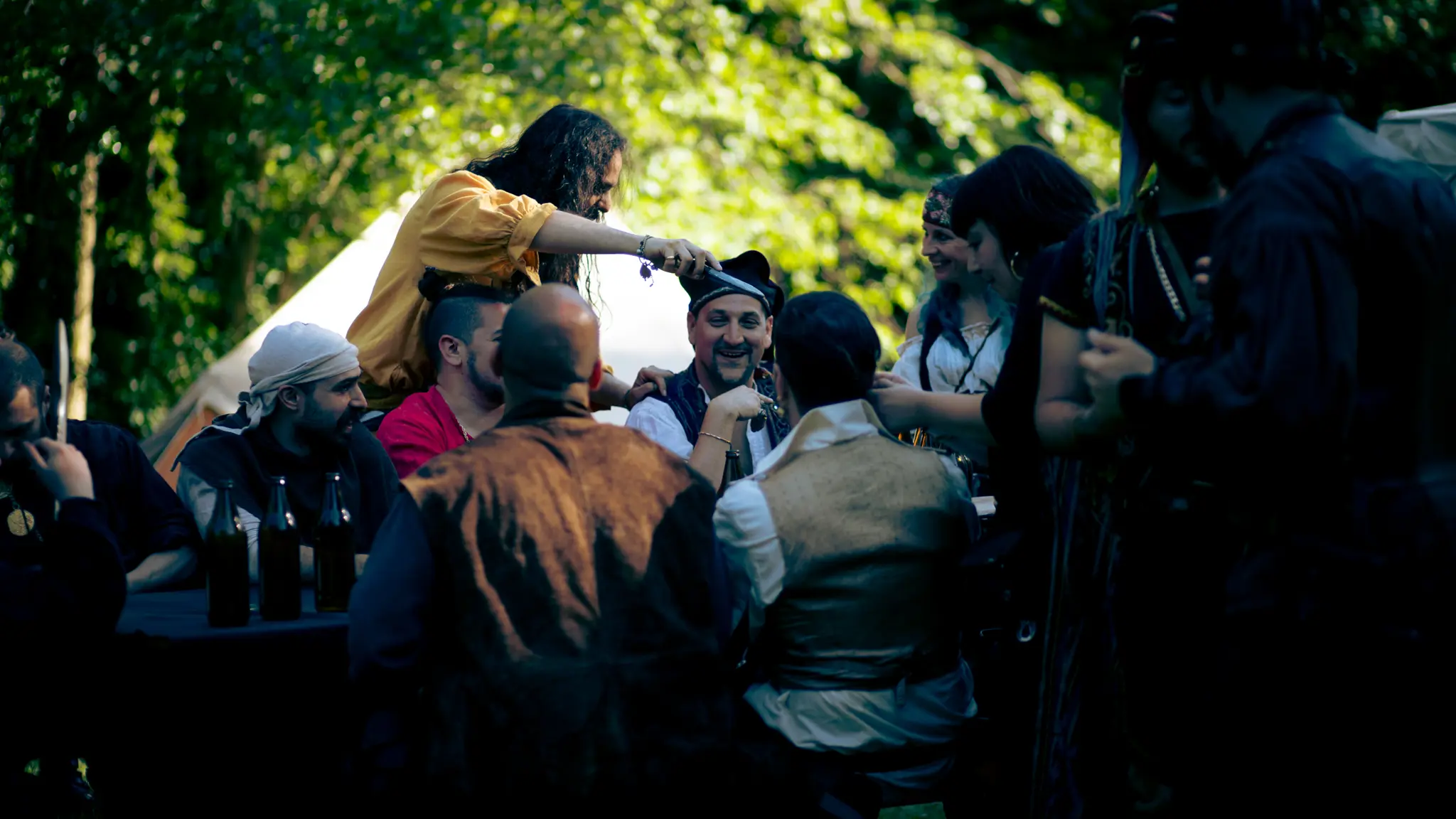
What does larp mean?#
Larp stands for Live Action Role Playing — an immersive experience in which participants embody fictional characters in a real environment, interacting with each other and with the space around them through shared rules of conduct, acting as though the fiction were reality.
It sounds complicated, but it isn't. In truth, we have all already tried it: anyone who as a child pretended to be a knight, an astronaut, or a character from a film has already played something very close to larp. That capacity has not gone anywhere.
In this article we try to explain what larp is in an accessible way, even for those who have never heard of it — going through its main elements and answering the questions we are asked most often.
What are the defining elements of a larp?#
Three fundamental elements define it: the role, the character through whom you act and take part in the story; the setting, which encompasses both the fictional world proposed by the narrative and the game system and rules that govern it; and the fictional agreement, the shared pact among participants to accept that fiction as legitimate and inhabit it for the duration of the game.
To give a concrete sense of what these elements mean, it helps to compare larp with more familiar forms of entertainment: simulations, tabletop role-playing games, improv theatre, video games. Larp shares something with each of them, while being something distinct from all four.
With tabletop RPGs, it shares characters, settings, and narrative choices. The difference is the body: at the table you narrate, in larp you move and speak in first person.
With improv theatre, it shares physical presence and spontaneous dialogue. The difference is the audience: in theatre you perform for someone, in larp every participant is simultaneously author and protagonist.
With video games, it shares the idea of an avatar in a constructed world. The difference is the medium: there a screen, here the body, the other participants, the physical space.
With simulations, it shares the constructed scenario and shared rules. The difference is in the role: in simulations you embody only the functional part of a character — the skills the situation demands. In larp, the character is complete: a history, desires, contradictions, an entire life to inhabit.
Larp: immersion and the magic circle#
The concept of immersion in larp describes how deeply a participant manages to identify with their character and the fictional world. It is a continuum: you move in and out at varying degrees of intensity, in a fluid movement between presence and distance. When it really works, that distance narrows until it almost disappears.
Game theorists call this space the magic circle: the threshold that separates the ordinary world from the fictional world. Entering it requires two distinct movements. The first is collective: the fictional agreement, the pact among all participants to respect and sustain the shared fiction. The second is individual: the suspension of disbelief, the personal choice to treat the fictional world as real for the duration of the game. When both happen, you are inside the magic circle — the rules change, emotions carry a different weight, time moves differently.
Immersion is built through many factors: the design of the space, the quality of the ruleset, the coherence of the setting, the depth of character writing. It can flourish in a solo larp or in the middle of hundreds of people. The one indispensable element, in every case, is the role.
The role in larp: avatar and shield#
A character in larp serves two distinct functions, often simultaneously. The first is that of avatar: an interface through which to move in the fictional world, make choices, build relationships, react to events. You are someone else — acting with their history, their desires, their limitations.
The second function is that of an emotional shield. The character allows you to explore emotions, conflicts, and situations that outside the game you might find hard to face. The character acts, and that distance is structure. It is the same mechanism that makes metaphor useful in therapy, or fiction useful in literature: distance allows you to get closer.
In practice, this means you can play a compulsive liar while being an honest person, confront loss through a character in grief, explore moral positions far from your own without being overwhelmed. The role protects you while letting you go deep. This is why many people describe larp as an emotionally intense experience approached with complete ease: they know they always have the option to step out of the fiction when they need to.
Game mechanics and rules in larp#
Every larp has a ruleset, though one conceived very differently from that of a board game. Rules in larp serve to build a shared space in which the story can happen. They establish what is possible, how conflict situations are handled, how narrative uncertainty is resolved, and above all how participant wellbeing is protected.
A fundamental distinction in any larp is that between in-game and out-of-game. Everything that happens within the fiction (actions, words, characters' emotions) is in-game. Everything that concerns participants as real people (a question, a clarification, a pause) is out-of-game. The two levels always coexist, and moving between them with fluency is a skill that develops with experience.
Larp theorists also speak of diegetic and extra-diegetic elements. Diegetic is everything that exists within the fictional world: the characters, props, dialogue, events of the story. Extra-diegetic is everything that belongs to the level of play while remaining external to the fiction: the rules themselves, safety signals, gestures for communicating with other participants outside of character. Good design tries to make diegetic everything the story needs, and to render extra-diegetic elements as invisible as possible — because every interruption of the fictional level has a cost in terms of immersion.
Managing this boundary is also where much of safety design takes place. Mechanics such as time-out (a pause in play), the safety word, or the gesture to step out of character are extra-diegetic tools that allow a participant to exit the fiction at any moment while preserving the magic circle for everyone else. They are an integral part of the contract of play.
A universe of variants#
The world of larp is vast, and its edges are blurrier than they might seem. Events can vary across almost every imaginable axis: duration (from an hour to several weeks), number of participants (from one to thousands), location (a flat, a forest, a castle, a ship), setting (fantasy, historical, science fiction, contemporary, horror), play style, narrative focus.
There are Nordic-style larps, born in Scandinavia in the 1990s, that prioritise psychological realism, emotional depth, and a departure from fantasy conventions. There are large-scale battle events with armour and latex weapons, where hundreds of people recreate epic medieval clashes. There are period costume larps, horror larps, larps that simulate political or diplomatic environments, larps that explore trauma or relationships.
Where larp goes#
In recent decades, larp has moved beyond hobbyist circles and become a recognised tool in many different fields. Its capacity to put people literally in someone else's shoes makes it extraordinarily effective wherever developing empathy, situational awareness, or relational skills is the goal.
In education, larp is used to teach history by reliving eras, to explore ethical questions in an embodied way, and to develop communication and listening skills. Some schools — particularly in Scandinavia, where larp has deeper roots — integrate it regularly into the curriculum.
In simulation and training, larp is the backbone of exercises like the Model United Nations: students and young professionals simulating UN diplomatic sessions, learning to negotiate, argue, and build coalitions. The same logic is applied in corporate, military, and medical contexts to train the management of critical situations.
Finally, larp is used as a tool for awareness: to give people a first-hand experience of discrimination, to simulate power dynamics, to build understanding of communities or conditions distant from one's own. As a direct experience, lived from the inside.
The heart of the larp experience#
Whatever the format, genre, or setting, the one thing all larps have in common is the centrality of experience. You live — or at least try to live — something otherwise out of reach: another life, another era, another version of yourself. The stakes are always the experience itself, and every participant is at once its author and its protagonist.
This is what makes larp unique among narrative media. A film tells you a story. A novel lets you imagine it. Larp makes you live through it. You are inside the scene: the decisions you make belong to the character, but you make them — with your emotions, your instincts, your presence.
How do you play a larp?#
Playing larp requires no prior experience or knowledge. In fact, for first-timers, arriving without too many expectations is often the best approach — letting the experience speak for itself makes it more genuine and surprising.
The most useful preparation, working through the materials the organisers provide, focuses on two things. The first is the setting: the fictional world proposed for the event, with its own rules, history, and internal logic. The better you understand the world you are entering, the easier it is to inhabit it. The second is the character: your avatar in that world, with an identity, a backstory, and desires of their own. It is through them that you will move, make decisions, and build relationships with the other participants.
Both of these are explored in dedicated sections of this article.
What if I get it wrong?#
Many people approach larp with hesitation: drawn by curiosity, but held back by uncertainty. The feeling of moving on unfamiliar ground, the fear of behaving awkwardly, of being judged in situations they have never encountered before.
But the question 'what if I get it wrong?' rests on a premise that has little place in larp. In a simulation, every direction is valid. Whatever choice your character makes is interesting; whatever emotion you feel feeds the story. The game is open: every participant brings their own version, and all versions enrich the experience.
The only thing to honour is the fictional agreement: staying inside the game for its duration, sustaining the fictional world that you and the other participants are building together. It is the same suspension of disbelief that applies when watching a film — with the difference that here, you are part of what is happening.
The Hours Larp#
The Hours is a collective working across two distinct formats: boutique larp and chamber larp. Both share the same underlying philosophy — small scale and care for the individual experience — while responding to different logics.
Boutique larp is our broader format: scenarios designed for small groups, with an attention to detail that only a contained scale allows. Chamber larp is an even more essential format: short, for a handful of participants, in an intimate space, with immediate atmosphere and minimal staging. Designed to be accessible to anyone, including those encountering larp for the very first time.
If you are curious to discover larp or want to know when we are running our next event, get in touch on social media.
Frequently asked questions#
Do I need experience to take part in a larp?#
Anyone can participate. As I mentioned earlier, we have all already played something like larp — when as children we used to play 'let's pretend'!
What can I do if I have never played and would like to try?#
Find an association or event that interests you and write to the organisers straight away! It is a hobby full of passionate people who will be delighted to help you find your footing in this world. You are welcome to get in touch with us on social media or by email too!
Do you need costumes to play larp?#
It depends on the format. Chamber larps, for example, are played in everyday clothes with no specific preparation. Some larps are played in ordinary dress, others require costumes — some provided by the organisers, others sourced by the participants themselves. The advice is always to ask the organisers before attending.
How long does a larp last?#
Larps can last anywhere from an hour to several weeks. There is no standard duration: it depends entirely on the format and type of event. The Hours events generally run between one and three hours. That is a deliberate choice — we prefer a short, intense experience over a long, fragmented one.
Is larp physically tiring?#
It depends on the format. In combat larps, with latex weapons or controlled physical contact, there can be real physical effort — in those cases, organisers use specific mechanics and precise safety rules. Many larps unfold entirely through dialogue and presence, with minimal physical involvement. Before attending, it is always a good idea to ask the organisers what kind of physical engagement is expected. Our events focus on the emotional and relational experience — the effort required is inward.
Is larp emotionally tiring?#
It can be, and it would be dishonest not to say so. Inhabiting a character in an intense situation, making choices that touch you, living through conflicts or losses even if fictional — all of this leaves a mark. That is not necessarily a bad thing: many people describe that tiredness as the same feeling you get after a beautiful film or a book that gripped you completely. The difference is that in larp you are inside the scene. Responsible organisers provide tools for managing emotional intensity — safety words, calibration between participants, and other small gestures of care. Our events always include these, so that everyone can have an intense and enjoyable experience in safety.
Is larp only for fantasy fans?#
Larp is a format, not a genre. There are contemporary larps, horror larps, historical larps, science fiction larps, dramatic larps, romantic larps. Fantasy is just one of the infinite possible settings, even if historically it is the most widespread. The Hours works in other genres — but we are sure there is an association near you that runs live fantasy! :)
What does 'stepping out of character' mean?#
It is the moment when a participant temporarily stops playing their character and speaks as themselves. It is used for safety reasons, to clarify something with other participants, or simply to take a break. Every larp has a specific signal for it — usually a gesture or a keyword agreed upon before the game starts.