Boutique larp: an analogy#
When we started looking for the right words to describe what we wanted to do, the boutique hotel analogy felt like the most interesting one: this kind of hotel works differently from chains or large properties, they have smaller budgets and so focus on care for detail, they hold fewer people and so focus on personalising the experience. It's a deliberate trade-off, what you lose in scale you gain in the pursuit of individual experience.
It's above all a model of work: large larp events build vast worlds, factions, collective epics, things a small event simply can't afford. We work on different terrain, with different tools and different goals.
From larp, to chamber larp, to boutique larp#
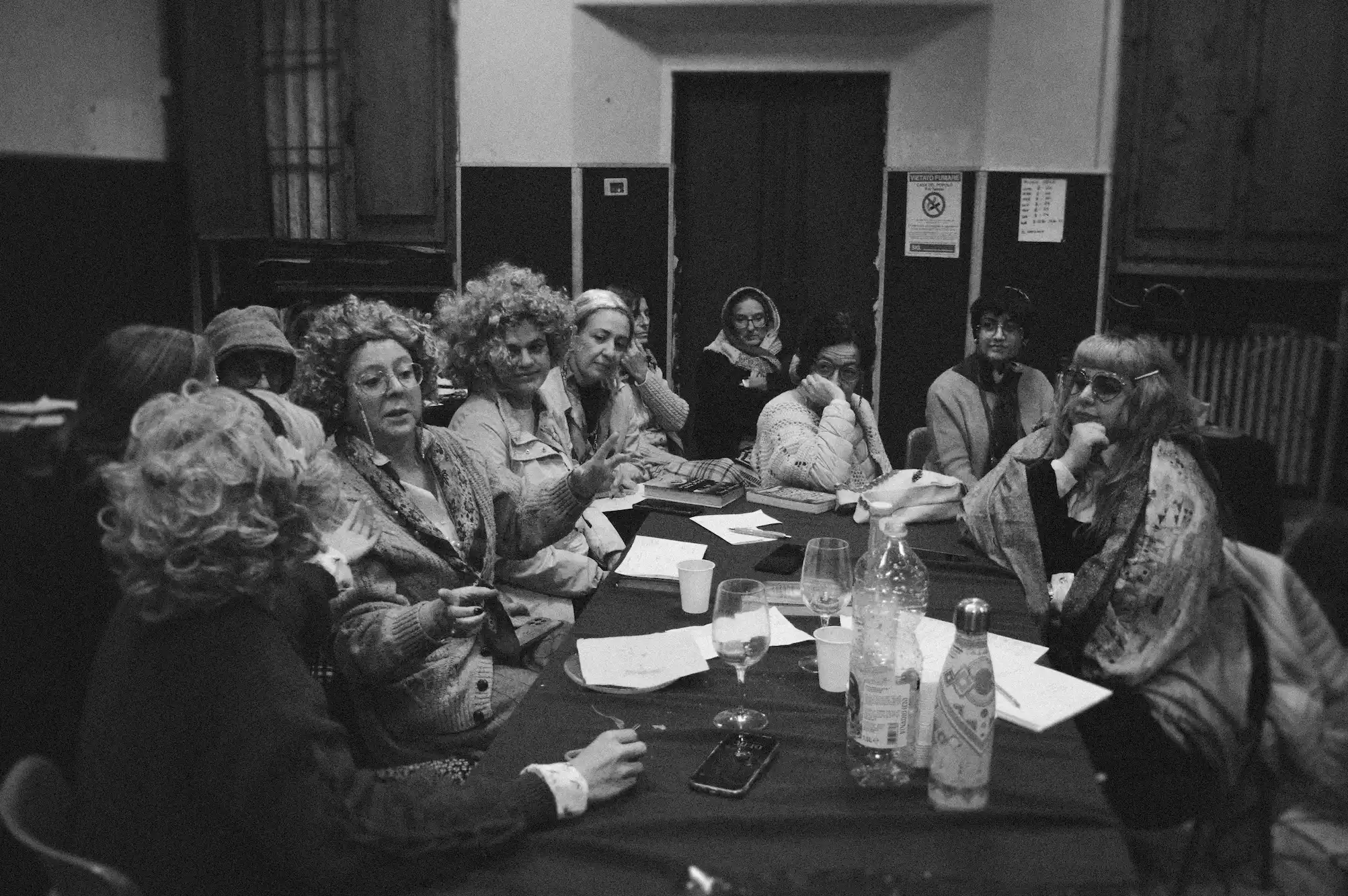
To get to boutique larp, we start where it all begins, classic larp, the kind played in costume: a format heavily dependent on location, one that needs to be able to host the setting. Much of what we do draws inspiration instead from chamber larp, a form of live-action roleplay designed to be short, for a small group of players, in a contained space, often a single room, whose name comes from chamber theatre, from which it also inherits its structure: tight narrative focus, setting stripped to the essential.
The format is essential, chamber larp needs no costumes or elaborate sets, and so its mechanics are designed to work with whatever time and space you actually have: you can change the setting, the cast, even the room itself, without having to rethink the experience from scratch. It's precisely in this essentialism that chamber larp has developed a precise aesthetic, one that has taught us a great deal about what really matters in a live-action roleplay experience.
This freedom is where boutique larp comes from, a hybrid that takes the logic of chamber larp and carries it beyond the single room, toward wider spaces and formats, keeping the same principles, few participants, contained space, limited duration, focused design, applied though to a broader context: a structure built to be inhabited.
Boutique larp design as reduction#
There's a line by Antoine de Saint-Exupéry that captures what we try to do when we write a boutique larp: 'Perfection is achieved not when there is nothing more to add, but when there is nothing left to take away.'
Designing a boutique event means above all resisting the temptation to add: every extra subplot takes attention away from the main one (or the other way round), every additional character is narrative space divided among more people, every added hour is tension that needs managing and rhythm that risks losing its footing.
The result of this reduction process is a clean event, where every element does exactly what it's supposed to do, with no background noise.
Time in boutique larp#
Playing in hours rather than days is also a concession to modern life, but above all it's a choice that takes seriously how immersive experience actually works.
Long larps face a structural challenge that goes beyond narrative design: keeping people engaged for many hours, or several days, is enormously difficult, not because the design is wrong, but because there are real physical and psychological limits to how long a person can stay inside the magic circle before feeling the need to step out.
The magic circle is the term used to describe the mental space of play, that state in which you suspend ordinary reality and move according to the rules of the fictional world: entering it takes effort, sustaining it takes energy, and leaving it, even just to eat or sleep, is a break from which you don't always return with the same intensity.
Working on shorter timescales means working within the natural limits of this window: the narrative arc begins when people are fresh and ends before attention fades, with no need to manage recovery, reignite immersion, or hold a world together across multiple nights. You build one thing, bring it to completion, and let it go.
Emotional sustainability in boutique larp#
There's an aspect of duration that goes beyond narrative structure: emotional sustainability. Playing larp requires inner work, engaging with often intense emotions, inhabiting characters in difficult situations, navigating conflict and tension inside the magic circle.
In multi-day events, managing emotional pacing becomes part of the design and preparation, for players and organisers alike. How long can a person sustain that intensity before wearing out?
In a one- or two-hour larp this problem largely disappears: most players can sustain a high level of intensity throughout without ever needing to pull on the brakes, and the natural flow of the game, with its micro-pauses and shifts in rhythm, is enough on its own. There's no need for emotional recovery mid-game, because the game ends before it becomes necessary.
Boutique larp as an accessible choice#
One of the goals of the boutique format is to reduce the burden on the player: certain larp events require months of preparation, long journeys, hotels booked well in advance, and we want to lower that threshold, making participation easy and immediate.
This translates into a format choice: boutique larp doesn't require a dedicated venue or custom production, and can be replicated in different contexts without losing coherence.
For the Time Being is a concrete example: the same scenario has been run in four different locations, including one in Rome, with a different cast each time.